rrb exam syllabus railway recruitment board allahabad recruitment in railway government job of west bengal electrical engineer jobs in sarkari naukri sarkari naukri government it jobs in india government jobs of delhi civil recruitment indian engineering service exam
Showing posts with label IRCTC. Show all posts

Friday, December 29, 2017

Year End Review 2017 of Ministry of Railways

Year End Review 2017 of Ministry of Railways

During 2016-17 consequential train accidents decreased from 107 to 104 in comparison to the corresponding period of the previous year. Track Renewal speeded up- 2148 km old rails have been replaced with new rails upto Nov'17.

Ground-breaking ceremony of the Mumbai-Ahmedabad High Speed Rail Project (MAHSR) by Hon'ble Prime Minister of India and Hon'ble Prime Minister of Japan held in September, 2017.

Introduced First AC EMU consisting of 12-car (12 coaches) fitted with "Indigenous" 3-phase Propulsion system of Ms BHEL on Mumbai Suburban Section.

Mission Retro-Fitment to revamp passenger coaches launched to enhance the passenger experience. It will cover 45,000 Coaches.

14 Rajdhanis and 15 Shatabdi trains were identified to significantly improve passengers experience under “Project Swarn".

Host of Passenger Amenities and Digital Initiatives were taken during the year 2017.

All time record commissioning of Electric Traction of 2367 route kilometer was achieve

PASSENGER AMENITIES, SERVICES

• From 03rd Nov. 2017, Service started to provide information to passengers through Short Messaging Service (SMS) regarding status of delayed trains. Initially, all Rajdhani, Shatabdi, Tejas & Gatiman Trains covered. From 15th Dec, 2017, all Jan shatabdis, Duranto and Garib Rath trains have also been included. Now this service is available in around 250 trains.
• Permitted m-Aadhar as one of the prescribed proofs of Identity for Rail Travel Purpose.
• Extension of Scheme of Alternate Train Accommodation System aka VIKALP for the benefit of Waitlisted Passengers with effect from 1st April, 2017 in all Mail/Express trains.
• Initiatives for The Senior Citizens -Persons With Disabilities: Indian Railways launched Quota of 2 Berths for Divyangjans & Senior Citizens in AC 3 class. This is in addition to existing quota of 4 berths in SL class.
• Online booking of Retiring Rooms has been commissioned at 497 railway stations of Indian Railways. With a view to ensure optimal utilization of available accommodation in Retiring Rooms and Dormitory, instructions have been issued to Western Railway for booking of Retiring Room as well as dormitory for minimum duration of 3 hrs except for night booking where the booking will be done mandatorily from 2100 hrs to 0900 hrs. This facility is presently available at Mumbai, Ahmedabad, Vadodara and Surat stations.
• New Catering Policy in Railways launched. 33% Sub Quota for Women in Allotment of each Category of minor Catering Units at All Category of stations has been provided under this policy. Roped in Self Help Groups To Make Local Cuisines Available Through E-Catering Services of its PSU IRCTC.
 • Initiated programme for 100% LED lighting at stations leading to improved illumination and passenger safety. Completed more than 3500 stations so far with a target to cover all Railway stations by March 2018.
• Provision of mobile/laptop charging points at all railway platforms.
• Provision of insect catchers at railway stations.
·        A new mobile app IRCTC Rail Connect launched. Aadhar linked user IDs have been allowed to book 12 e-tickets in one month as against 6 tickets for non Aadhar user IDs.
• A new Integrated Mobile App 'Rail SAARTHI' launched which provides various services viz. Rail e-ticket booking, unreserved ticketing, complaint management, Clean my Coach, passenger enquiry etc.
• Payment of ticket using UPI/BHIM App has been implemented at reservation counters as well as on e-ticketing website.
 • Project Swarn - 14 Rajdhanis and 15 Shatabdi trains were identified to significantly improve passengers experience under “Project Swarn".  To achieve the objectives under this Project, 'staff behaviour' was identified as an important parameter.  The frontline staff of these premier trains was trained in various aspects such as catering, linen management and cleanliness. 

 HIGH SPEED RAILWAY/ MOBILITY
• A road map developed to increase speed of trains by overcoming the existing impediments on Principal routes of the railways on Golden Quadrilateral(GQ) along with diagonals (Delhi - Mumbai, Delhi - Howrah, Howrah- Chennai, Chennai - Mumbai, Delhi - Chennai and Howrah - Mumbai) due to fixed infrastructure, movable infrastructure, and operational practices.
• Projects for two routes viz. New Delhi- Mumbai Central (including Vadodara- Ahmedabad) and New Delhi- Howrah (including Kanpur- Lucknow) for raising of speed to 160/200kmph have been included in WP 2017-18 at Rs. 18,000 crores approximately. Speed Enhancement project entails works such as through fencing, removal of level crossings, train protection warning system (TPWS), mobile train radio communication (MTRC), automated and mechanized diagnostic systems etc. which will considerably enhance safety and reliability. The main outcome of the implementation of the projects is increase in the maximum speed of the trains to 160/200 kmph. This will reduce the travel time of premium Rajdhani type trains to 12 hours as against the present travel time of 17 hours for Howrah Rajdhani and 15 hours 35 minutes for Mumbai Rajdhani.
 • Replacement of loco hauled commuter trains with MEMU/DEMU trains: MEMU trains have a potential for average speed increment of up to 20kmph in comparison to loco driven passenger trains.
 • Ground-breaking ceremony of the Mumbai-Ahmedabad High Speed Rail Project (MAHSR) by Hon'ble Prime Minister of India and Hon'ble Prime Minister of Japan was held in September, 2017. Managing Director and other Directors in the National High Speed Rail Corporation Limited (NHSRCL), constituted for implementation of the MAHSR project, have been appointed.
• Following Semi High Speed Studies are underway:
o    Delhi-Chandigarh (244 km): Final report of feasibility cum implementation study of New Delhi-Chandigarh Corridor for raising the speed of passenger trains to 200 kmph by SNCF/France has been received. Report under scrutiny.
o    Nagpur - Secunderabad (575 km): A Protocol under co-operation MoU has been signed between Ministry of Railways and Russian Railways for carrying out feasibility cum implementation study. Work started in June 2016 and progressing as per schedule.
o    Chennai- Kazipet by German Railways- Joint declaration of intent has been signed between both the parties on 10/10/17 for raising the speed of passenger trains to 200kmph on the existing route on 50:50 cost sharing basis. The feasibility study shall be carried out after signing a separate agreement, which is under finalization.
o    Feasibility study for High Speed Rail on Mysuru-Bengaluru-Chennai through Government to Government (G2G) with the Government of Germany has commenced.

SAFETY
• During 2016-17 consequential train accidents decreased from 107 to 104 in comparison to the corresponding period of the previous year.  In the current year from 1st April, 2017 to 30th November, 2017 consequential train accidents decreased from 85 to 49 in comparison to the corresponding period of the previous year. 
 • During the year from January to December 2017 to give thrust to safety related issues, Safety drives were launched on all zonal railways with a view to prevent accidents.
 • Emphasis on night inspections and ambush checks regularly by officers and supervisors, review of fracture prone locations, frequent and intensive footplate inspection, etc.
 • Focus on monitoring practices associated with booking, counselling, training, PME, performance evaluation etc. of crew in view of SPAD by Loco Pilots.
 • A special safety drive regarding - “Working on running lines" and “Safety at work sites" for a period of fifteen days to check incidences of uncoupling in passenger train (Locomotive Getting Separated from Formation).
 • Gate Mitras were deployed at all unmanned level crossings (UMLCs) on Broad Gauge instead of only identified UMLCs in order to enhance safety. 
 • Under Rashtriya Rail Sanraksha Kosh (RRSK) a provision of `20,000 crore has been made in 2017-18 out of 'RRSK' to fund essential works for ensuring safety.
High Level Safety Review Committee (HLSRC): A High Level Safety Review Committee under the Chairmanship of Dr. Anil Kakodkar, former Chairman, Atomic Energy Commission was constituted on 16.09.2011 to go into all technical and technology related aspects in connection with safe running of train services in the country. The Committee submitted its Report on 17.02.2012.  All the 106 recommendations of the Committee have since been deliberated upon and 87 recommendations have been found fully/partially acceptable and 19 have not been found acceptable to the Ministry of Railways.
·   Of the accepted recommendations, 65 have been fully/partially implemented. The remaining recommendations are at various stages of implementation.
 ·       Target of Eliminating All Unmanned Level Crossing preponed to 2018. Till the time this is achieved, in the interim period, Indian Railways decided to deploy Gate Mitras. Gate Mitra is an initiative where a person will be deployed at a UMLC, and would alert road users about approaching trains. All UMLCs on Broad Gauge as on November 2017 were provided with Gate Mitras.
 ·     Track Renewal speeded up: 2148 km old rails have been replaced with new rails upto Nov'17.Progress during corresponding period last year was 1624 km between April to Nov'16.
 •  Self-Propelled Ultrasonic Rail Testing (SPURTZ Car) is under procurement and trial of Ultrasonic Broken Rail Detection System is underway. Train Protection and Warning System (TPWS) is under implementation on Suburban/High- density Routes.
 •  Decided to switch over to 100 % manufacture of Linke Hofmann Busch (LHB) coaches as these have numerous advantages over ICF coaches including higher speed and safety especially during derailment and collisions. Completely switch over to LHB coaches production from 2018-19.

SYSTEM IMPROVEMENT AND INNOVATION
•   Comprehensively revised categories of various Railway Stations. In new scheme of station categorization, even the small stations, because of footfall criteria, to get the higher level of passenger amenities leading to better passenger satisfaction.
• Introduced and proliferated Global Positioning System (GPS) based 'Fog Pass device' which displays the name and distance of approaching signals and other critical signal landmarks in advance during train operation. At present total 7263 Fog Pass Devices have been procured and being used in NR, NER, NCR, ECR, NFR& NWR which are the most fog affected Railways.
• Major Transparency measures by RDSO:
a) “New Online Vendor Registration System" has been launched by RDSO with effect from 8th Nov 2017- With the new online system implemented by RDSO since 8th Nov 2017, the Vendor can now deposit registration fee, submit documents, download technical drawings & specifications and interact with RDSO online.
 b) All RDSO controlled items have now been listed on RDSO website with specific timelines for Vendor Registration process for each individual item. RDSO will endeavour to complete the registration process for which the vendor applies within defined timelines.
c) Innovation Challenge: An Innovation Challenge has been conducted to invite ideas and to augment the pace of Indian Railways operational improvements through innovative methods. Innovation Challenges attracted a huge response and a total of 4683 entries were received.  RDSO has been entrusted the task of conducting the screening and evaluation process.  The Innovation Challenge has been conducted in the following 06 areas:
(i)           Accessibility to trains from low level platforms
(ii)         Increasing capacity of coaches
(iii)       Digital capabilities at stations.
(iv)       Design of Wagons for efficient loading and transportation of new commodities.
(v)         New Idea/ Suggestion to improve the working of Indian Railways.
(vi)       Increasing Non-fare revenue of Indian Railways.

TRANSPARENCY
• Online Tracking of Contractor's Bill enabled on single website - IT enabled real-time Web based system has been developed for tracking bill payments. This system enables the registered vendor/contractor to track status of bills from the time they are submitted to the Railways till the final payment is made.
• Implementation of 100% Digitization of Receipt Note.
• Digital finalization of tenders - Total 54700 tender cases finalized this year digitally through Indian Railway E-Procurement portal www.ireps.gov.in.
• More than 1000 e-Reverse Auction tenders opened on Indian Railways web portal during last 1 year.

NEW TRAINS
• India's First Tejas Express Between Mumbai and Karmali inaugurated.
 • More Than Three Decade Old Demand for an “Express" Train for People of Kirandul in Dantewada District of Chhattisgarh fulfilled. Extended Train No. 08152 Visakhapatnam - Jagdalpur Upto Kirandul.
• Prime Minister of India & Prime Minister of Bangladesh Jointly along with Chief Minister, West Bengal Flagged off New Cross-Border Train between India & Bangladesh, “Kolkata-Khulna Bandhan Express" from Kolkata.
 • Introduced tri- weekly new Special Rajdhani between Delhi - Mumbai route from 16th October, 2017.
Introduced First AC EMU consisting of 12-car (12 coaches) fitted with “Indigenous" 3-phase Propulsion system of Ms BHEL on Mumbai Suburban Section.
 • Introduced Third Mahamana Express to run between Varanasi and Vadodara on 22nd September 2017.
Vistadome Tourist Coach with glass walls launched at Vishakhapatnam to run between   Visakhaptnam and Araku Valley. The Vistadome coach has features like glass roof, LED lights, rotable seats, GPS based info system etc will offer to tourists to enjoy scenic beauty not only at destination but also along the journey.
• Introduced Train No.22165/22166 Bhopal-Singrauli  Express (Bi-Weekly):
 • Introduced Train No 22167/22168 Singrauli-H. Nizamuddin Express(Weekly) :
 • Introduced Train No 18109/18110 Jammu Tawi-Rourkela Express (Daily) Upto Sambalpur:
 • Introduced Train No 22913/22914 Bandra(T)-Patna Humsafar Express (Weekly)
 • Introduced Train No 22921/22922 Bandra(T)-Gorakhpur Antyodaya Express (Weekly)
 • Introduced Train No 22434/ 22433Anand Vihar (T) To Ghazipur (Bi-weekly) via Kanpur, Allahabad:
 • Introduced New DEMU Service between Baiyappanahalli-Whitefild-Baiyappanahalli.
• Introduced Train No 22163/64 Bhopal- Khajuraho Mahamana Intercity Express (Daily),
 • Introduced Train No 22833/34 Bhubaneswar- Krishnarajapuram Humsafar Express  (Weekly)
 • Introduced Train No 17323/17324 Hubballi - Varanasi - Hubballi Express (Weekly)
• Introduced Train No 17325/17326 Hubballi - Mysuru - Hubballi Express (Daily)
• Introduced Train No 16791/16792 from Punalur to Palakkad.
 • Introduced Train No 22992/22991 Veraval - Bandra Terminus Super Fast Express
• Introduced Train No 22994/22993 Mahuva - Bandra Terminus Super Fast Express
• Introduced Train No 19030/19029 Mahuva - Bandra Terminus Super Fast Express
• Introduced Train No 58653/58654 Ranchi-Barkichanpi Passenger upto Tori
• Introduced Train No Train No 14715/14716 Sri Ganganagar - Tiruchirappalli Humsafar Express (Weekly) (via Krishnarajapuram, Pune, Ahmedabad) the fourth Humsafar clan of trains
·    Introduced Train No Train No 22877/22878 Ernakulam - Howrah Antyodaya Express (Weekly) (via Salem, Katpadi, Visakhapatnam) first Antyodaya clan of trains.
• Extended Train No. 19653/19654 Ajmer Ratlam Express Extended up to Indore.
 • Extended Frequency of Train No.22419/22420 Ghazipur City-Anand Vihar (T) Suhail Dev Express from tri-weekly to four days a week.
 • Extended Frequency of Train No.19041/19042 Bandra (T)-Ghazipur City Express (weekly to bi-weekly). 
• Extension of Train No.58429/58430/58431/58432 (Khurda Road- Bolagarh) passenger trains extended upto Nayagarh Town.

INFRASTRUCTURE
• The first Phase of the Station Redevelopment Program comprising 23 major Railway Stations of Indian Railways was launched.
• Mission Retro-Fitment to revamp passenger coaches launched to enhance the passenger experience. It will cover 45,000 Coaches.
• Significant Step taken towards Providing Rail Connectivity for Chardham Pilgrimage in the State of Uttarakhand through commencement of final location Survey.
Record Commissioning of sections on Electric Traction: During the calendar year 2017, all time record commissioning of Electric Traction of 2367 route kilometer was achieved. A target for electrification of 4,000 route kilometer has been set for achievement during financial year 2017-18.
Major Strategic Decisions to speed up 100% Electrification work-
a)  For Rail Electrification projects, Provision of “Deemed approval" has been made for various drawings/schematic/plan wherever approving authorities do not take decision within specified timelines.
b) In future, doubling, new line and gauge conversion projects for the sections shall be simultaneously assessed with electrification.
c) To avoid multiplicity of agencies involved in execution, it has been decided that “Henceforth, where electrification and doubling works have been sanctioned both works should be executed by the same agency.
d) It has been decided to go for large size contracts on EPC mode on case to case basis, preferably adopting EPC (turnkey) based contracting system or large composite item rate contract in package size of 300/500/1000/1500RKMs.
Opening of Major Routes On Electric Traction: During the calendar year 2017, commissioning of missing links have resulted in better linkages and seamless connectivity on following routes:
o   Commissioning of Andal-Sitarampur section,
o   Commissioning of Indore-Mhow section.
o   Commissioning of Singapur Road - Lanjigarh - Titlagarh section
o   Commissioning of Lapanga - Sambalpur section.
o   Commissioning of Una Himachal - Amb Andura section.
o   Commissioning of Lalitpur - Udaipurasection.
o   Commissioning of Walgaon - Narkher section.
o   Commissioning of Manpur-Tilaiya-Bakhtiyarpur section.
o   Commissioning of Ramanagaram-Mysore section.
Energy Management: Dedicated transmission line network of railway-8000 Km network planned. Existing transmission line network from Dadri-Kanpur extended up to Allahabad. Work in progress for Allahabad-Mughalsarai transmission line network.
Electric Locomotive Factory at Madhepura in Bihar (Make in India project)- First phase of construction of factory has been completed. First prototype locomotive under assembly at the factory and expected to be rolled out by Feb.'18 as per time line. Manufacturing of High Horse Power Freight locomotives (9000 hp) for hauling longer and heavier trains with improved mobility. Manufacturing of High Horse Power Passenger locomotives (9000 hp) for improving average speed of coaching trains in this Locomotive Factory at Madhepura.
• Technological Interventions for Crew Comfort inside locomotives:
(a)          Water Closets in Locomotives
(b)         Cab air conditioners
(c)          Improved Cab Ergonomics and layout
• Distributed Power Wireless Control System (DPWCS) for hauling longer and heavier freight trains with two or more locos in between train configuration.
• Technological Interventions for Safety - Crew Voice and Video recording system.
• New Era of Green Technology (HOG power supply) with use of Hotel load converter on electric locomotives in WAP-7 locomotives and in WAP-5 locomotives. Provision of Hotel load converter on locomotives, eliminates the use of diesel generator cars, thereby replacing power cars by passenger carrying coaches.

DIGITAL INDIA INITIATIVES
• For incentivizing people to opt digital transactions, IR has  withdrawn service charge from booking of e-tickets, offered free insurance of Rs 10 lakhs on e-tickets and 0.5% discount on Season Tickets purchased through digital means etc.
• Around 9,500 POS machines have been installed at various ticket booking counters to accept payment from Debit/Credit cards.  No MDR is charge for booking through Debit cards at ticketig counters.
• The facility of payment through UPI/BHIM has been provided at PRS counters.
• Rail Cloud Project launched - To achieve the goal of single digital platform for Indian Railways.
• RailsaverApp developed and its utilization popularized with the railways.
• Implementation of e-office in the Railway Board.
• Implementation of on-line submission and assessment of Annual Performance Appraisal Report (APAR) through SPARROW for officers of Indian Railways.
• Digitization of old Annual Performance Appraisal Reports (APARs) of Group-A Officers of Indian Railways.
• Launching complimentary Wi-Fi facility at National Rail Museum (NRM), New Delhi, first museum in India to have such facility.
• Agreement with M/s Google Cultural Institute (GCI) for digitization of Railway Heritage and bringing them online for universal access and creating awareness among future generations.
• In collaboration with Google Cultural Institute , launched an innovative programme for dissemination of India's rich cultural heritage to railway passengers through video screens at Chhatrapati Shivaji Maharaj Terminus, Mumbai.
• In collaboration with ISRO, expediting use of space technology on Indian Railways for various projects like Real Time Train Information System, Advance Warning System at Unmanned Level Crossing Gates
• In order to promote digital payments, preference in Upgradation to those passengers who have booked ticket through digital mode of payment has been implemented.

 FREIGHT
Liberalised Automatic Freight Rebate Scheme in Empty flow Directions has been issued w.e.f.01.01.2017 by modifying earlier TEFD Scheme.
Policy on Long Term Tariff Contract with key freight customers has been issued on 30.3.2017. Total 24 proposals were received and out of them, 21 proposals / agreements have been signed. The major companies who have entered into contact with Zonal Railways under this scheme included TATA Steel, Ultra-tech Cement, India Cement, Jindal Steel and Power, J.K. Cement, Ambuja, ACC etc.
Double stack dwarf container introduced as a new delivery model to increase Loadability and attract new traffic under wire.  New tariff policy granting 17% rebate to Double Stack Dwarf Container trains has also been issued on 14.07.2017.
Right Powering of freight trains: To provide high speed to freight trains and ensure swift movement of goods, New policy introduced for right powering arrangement for freight trains with a horse power to trailing load ratio of 1.5-2.0 for improving average speeds.
• New Partnership with India Post for Business Parcel launched.
Mission Hundred' - Commissioning of PFTs/Sidings- 45 terminals have been commissioned during 2016-17. Out of the remaining 55 terminals, so far 13 terminals have been commissioned in 2017-2018.

FINANCE
• Inaugurated the following policy initiatives for non fare revenue viz.,  Policy Initiatives of Increasing Non Fare Revenue like Out of Home Advertisement,  Content on demand,      Branding of Trains,      Non-fare Revenue Policy,      ATM Policy and  Initiatives promoting ease of ticketing through digital transactions (for reserved as well as unreserved passengers)
• Savings of Rs. 512 Cr.(approx.) has been achieved since July'17 by adopting best procurement policies/practices like Design modification, change in specification, challenging consumption, Long Term Contracting, Reverse Auction, improving vendor base etc.

MAKE IN INDIA INITIATIVES
• Policy on Public Procurement (Preference to Make in India) dated 15-06-2017 implemented.
• Policy for providing Preference to Domestically Manufactured Iron & Steel Products (DMI&SP) implemented.
• Policy for preference to Domestically Manufactured Electronic Goods issued by The Ministry of Electronics and Information Technology (MeitY) in October, 2017.
• Relaxation from condition of prior turnover and prior experience for Startups and Medium Small Enterprises.
Vendor meets organized on PAN-India basis at 12 prominent locations across the country in association with MSME & SIDBI during October & November 2017 with special emphasis on development of indigenous firms.

SECURITY
• Seats earmarked for Security Personnel of escorting teams in the trains. Berth no.63 in S1 Coach of the train earmarked for Security Personnel so they can be located easily in case of need.
• Railway Protection Force decided to extend Child Rescue Campaign in 47 additional Railway Stations taking total to 82 Railway Stations. The campaign had been successfully implemented in 35 existing Railway Stations. RPF rescued around 21,000 children in last three years.

GREEN INITIATIVES
• Dedicated Green Corridor in Bhagalpur- Banka section (Bihar) of Malda Division.
• Dedicated Green Corridor-Madhupur-Giridih section of  Asansol Division.
• 500 Kwp Solar Roof Top System commissioned at Mysuru Work Shop.
• Indian Railways Organization for Alternate Fuel (IROAF) sets gold standards by winning Golden Peacock Award for Eco Innovation for the year 2017 for introducing eco friendly and cost saving Dual Fuel 1400 HP Diesel engines on DEMU trains.
• First DEMU Train with Solar powered Coaches inducted into service of the Nation.
• New Water Management Policy with respect to consumption and utilization in Railways was released.
• GreenCo Certificates developed by CII given to Three Units of Indian Railways viz. Diesel Locomotive Works (Varanasi), Perambur Carriage Works (Chennai), Lalaguda Carriage Workshop (Hyderabad)
• Various new initiatives taken for improving energy efficiency- Replacement of all electrical equipments at railway stations and service buildings with energy efficient BEE star rated equipments under ESCO model, 100% LED lighting at all the railway stations, service buildings, workshops, Sheds and other installations etc. With this, savings of Rs. 125 Cr. achieved this year by saving about 7% energy.
• Building Management Information System (BMIS) implemented at Rail Bhawan including LED lights which shall save about Rs.30 lacs per annum in the energy bill.
• Policy for use of energy efficient equipments by all vendors issued to the railways.
• More than 60 MW of solar & wind power plants have already been installed covering 270 stations & 120 administrative buildings & hospitals and further orders for about 150 MW have been  placed for solar plants on roof tops of Railway Buildings.
• An International Conference on Green Initiatives and Railway Electrification organized in October 2017.

HUMAN RESOURCE
Project Saksham Launched : The decision of imparting a week-long training in skills and domain knowledge to all the employees of Indian Railways had been taken. The focus of all such training is to 'make a difference' to the job performance.
• Station Directors in large Stations have been now given the powers of the Branch Officers in the divisions to enable them to take decisions for smooth operations.
• Employee Charter was released. An employees' charter is notified for ensuring time bound redressal of railways employees' issues related to dues, entitlements and grievances.
• NIVARAN- Portal for Grievance Redressal of Railway Employees was launched.
•  Cashless treatment Scheme in Emergency (CTSE) Scheme was launched for Railway Employees.
• DRMs /Chief Workshop Managers (CWMs) have been given powers to re-engage retired railway employees up to 62 years of age against vacancies.
• NRTU is being established at Vadodara, Gujrat to give impetus to research and training in rail transport.
• In order to improve the functioning of Railways, substantial financial and administrative powers covering a wide spectrum of working have been delegated by the Railway Board to General Managers (GM),Divisional Railway Managers (DRM) and field officials.
• Number of posts of Additional Divisional Railway Managers (ADRMs) in all the railway division offices for better supervision.
• A Five Member Committee of senior officials of Railway Board to suggest measures for making substantial improvement in worksites safety over all Indian Railways network.

SPORTS
• Ministry of Railways felicitated Indian Railways Women Cricketers of Indian Women Cricket Team for their outstanding performance in Women World Cup 2017. It is a moment of great pride for Indian Railways that of the squad of 15 players of Indian Women Cricket Team, 10 Women Cricketers were from Indian Railways.
• Mirabai Chanu, Indian Railways Sportsperson, became the first Indian in over two decades to claim a gold medal at the World Weightlifting Championship in Anaheim, USA.

MOUs
• MoU between India and Switzerland on Technical Cooperation in Rail Sector
• Memorandum of Understanding signed between Rail Land Development Authority(RLDA) & IRCON International Limited for Redevelopment of Delhi Safdarjung Railway Station.
• India and Italy Sign an MOU for Technical Cooperation in Rail Sector Especially on Safety Related Subjects. MoU with Ferrovie Dello Stato Italiane S.P.A. of Italy on Technical Cooperation in the Rail Sector.
• Memorandum of Understanding (MoU) / Memorandum of cooperation (MoC) with Foreign Ministries/Railways for Technical Cooperation in Railway Sector.
• Memorandum of Understanding with UNESCO, New Delhi for preparation of Comprehensive Conservation Management Plan (CCMP) of Darjeeling Himalayan Railway (DHR), UNESCO World Heritage Site. This will boost conservation of DHR and promote hill railway tourism.
• MoU between Rail Land Development Authority (RLDA), an institution under Ministry of Railways and National Building Construction Corporation (NBCC), a PSU of Ministry of Urban Development regarding redevelopment of identified railway stations.
• MoU with Taiwan for bilateral cooperation in promoting rail heritage on both sides.

MISCELLANEOUS
• Century old Steam Loco EIR-21 (year built 1855) has been revived and steamed at Chennai.
• NG Steam Loco ZB-66 has been revived and steamed up at Kalka Shimla Section after a gap of several decades.
• Neki ki Rail" a seminar for improving the Railway's social footprint and impacting society in a positive manner Organised by Ministry of Railways at National Rail Museum.
• Notification for setting up of Rail Development Authority (RDA) issued in May, 2017. In order to operationalise the Authority, process for appointment of Chairman and Members of the RDA has been initiated.

Promotion of Tribal /local Art at Stations: To showcase tribal/local art at stations,  select tourist stations at 24 locations were identified and Zonal Railways concerned were requested for aesthetic up gradation of these stations with local/tribal art.
• The 'Fairy Queen', the oldest surviving functional steam engine in the world commenced its journey from National Capital Delhi to Rewari, Haryana after a gap of 5 years. This train, which is a great attraction among steam engine lovers across the globe, will run between Delhi Cantt. Station and Rewari

PIB

Wednesday, April 12, 2017

New Catering Policy in Railways

 New Catering Policy in Railways
New Catering Policy has already been notified on 27th February, 2017 with the objective to provide quality food to rail passengers by unbundling of catering services on trains. Indian Railway Catering and Tourism Corporation Limited (IRCTC) has been mandated to carry out the unbundling by creating a distinction primarily between food preparation and food distribution. In order to upgrade quality of food preparation, IRCTC shall be setting up new kitchens and upgrading existing ones. New Catering Policy, inter-alia, includes the following features for unbundling of catering services

(i) IRCTC shall manage catering services on all mobile units.
(ii) Meals for all mobile units will be picked up from the nominated kitchens owned, operated and managed by IRCTC.
(iii) IRCTC will engage service providers from hospitality industry for service of food in trains.
(iv) IRCTC shall not outrightly outsource or issue licenses for provision of catering services to private licensees. IRCTC shall retain the ownership and shall be fully accountable for all the issues pertaining to setting up and operation of the Base Kitchens and quality of food.

33% sub quota for women in allotment of each category of minor catering units at all category of stations has been provided in the new Catering Policy 2017.

In compliance of provision in Budget 2016-17 that IRCTC would begin to manage catering services in a phased manner, new Catering Policy 2017 has come into effect on 27.02.2017 in supersession of Catering Policy 2010. The implementation and roll out plan will have essentially two sub components:- (i) Take over scheme for static /mobile units both departmental and licensee operated units. (ii) Unbundling implementation including identification of sectors and subsequent sequencing for takeover. Accordingly, in the first phase, IRCTC would take over 52 mobile units and 38 static units over the New Delhi -Mumbai (NDLS-BCT) route within the calendar year 2017 wherein contracts awarded by Zonal Railways through Standard Bid Document will be reassigned to IRCTC for starting the unbundling process.

This Press Release is based on the information given by the Minister of State for Railways Shri Rajen Gohain in a written reply to a question in Lok Sabha on 12.04.2017 (Wednesday).

Supply of Rail Neer

Supply of Rail Neer

At present, Rail Neer is mandatorily supplied to passengers of all Rajdhani/Shatabdi/Duronto/Suvidha trains. There is also mandatory supply of Rail Neer in 139 pairs of trains and 200 stations as identified by the Ministry of Railways. For remaining trains/stations, other brands of Packaged Drinking Water (PDW) bottles are being supplied to the passengers, as approved by the Zonal Railways. Presently, approximately 6 lakh litres of packaged drinking water is being supplied to passengers all over the Indian Railways, through production in seven Rail Neer plants located at Nangloi, Delhi (2003), Danapur, Bihar (2004), Palur, Tamil Nadu (2011), Ambernath, Maharashtra (2014), Amethi, Uttar Pradesh (2015), Parassala, Kerala (2016) and Bilaspur, Chhattisgarh (2017). However, since the estimated demand for PDW is approximately 25 lakh litres per day, six more Rail Neer plants are planned to become operational in the next two years which will augment the total capacity to approximately ten lakh litres per day. In addition, 1106 Water Vending Machines set up by Indian Railway Catering & Tourism Corporation (IRCTC) have been installed at 345 stations for dispensing drinking water to passengers at prescribed rates in refills and with containers as under:-


Another 1100 Water Vending Machines are planned to be installed on other railway stations shortly. Further, all railway stations already have provision of potable drinking water on all platforms to satisfy the needs of rail passengers, free of cost. On most of the important stations, water coolers and chiller plants are also in operation for providing cold drinking water to passengers during the summer season.

This Press Release is based on the information given by the Minister of State for Railways Shri Rajen Gohain in a written reply to a question in Lok Sabha on 12.04.2017 (Wednesday).

Friday, March 24, 2017

Net Profit of IRCTC

Net Profit of IRCTC
Ministry of Railways
Press Information Bureau
Government of India
24-March, 2017 17:04 IST 

The net profit of Indian Railway Catering and Tourism Corporation Limited (IRCTC) has grown to Rs. 189 crore in Financial Year 2015-16 as against Rs.131 crore in Financial Year 2014-15. It is a growth of 44%.

During the year 2015-16, a total of Rs. 24,023 crore has been collected towards the sale of train tickets through IRCTC portal.

The revenue is generated from the following activities:-
(i) Service charges on internet tickets (ii) Sales of Rail Neer packaged water (iii) Sales of on-board catering services. (iv) License fee from outsourced catering vendors. (v) Revenue from tourism services.

This Press Release is based on the information given by the Minister of State for Railways Shri Rajen Gohain in a written reply to a question in Rajya Sabha on 24.03.2017 (Friday). 

Tuesday, March 21, 2017

Railways to provide fresh food cooked after every two hours

Railways to provide fresh food cooked after every two hours

New Delhi: Plagued with complaints, Railways plan to provide fresh food cooked at base kitchens in trains after every two hours to the passengers.

Railways, which provides about 11 lakh meals to passengers every day, has separated cooking and distribution of food under the recently launched new catering policy.

"We have decided to provide good quality food to our passengers and for that we have decided to have base kitchens at several places so that fresh food can be picked up at every two-hours of travel," Railway Minister Suresh Prabhu said at the round table conference on catering here.

Participated by representatives from the food and beverage industry, self-help groups, senior IRCTC and railway officials, the round table conference aims to formulate a roadmap under the new catering policy to provide best catering service at rail premises.

Admitting complaints against food served in trains, Prabhu said, Whenever complaints come we always take prompt action. We had detailed discussion before formulating the policy and today we are having discussion for its smooth implementation.

 Taking note of overcharging of food in trains, he said the issue will be taken up at the conference today. We have announced a new catering policy. There were many complaints against catering service. There were complaints against those who have got the catering responsibility under our earlier catering policy, he said.

Seeking participation of private players in food business for setting up base kitchens near stations, Prabhu said, We have decided how to provide good quality food to our passengers. So we decided to have base kitchens at many places across the country. The base kitchens will be mechanised kitchens with less human intervention. It can be done through PPP mode.

He said base kitchens will benefit passengers as fresh food can be picked up in trains in every two hours which even airlines cannot do. On the distribution front, Prabhu also sought participation of reputed caterers.

Delivery of food is important for an effective catering service. Delivery of fresh food in trains can also be done by reputed caterers with proper quality control mechanism, he added.

PTI

Monday, November 14, 2016

IRCTC: Counter Ticket Cancellation Procedure

IRCTC: Counter Ticket Cancellation Procedure


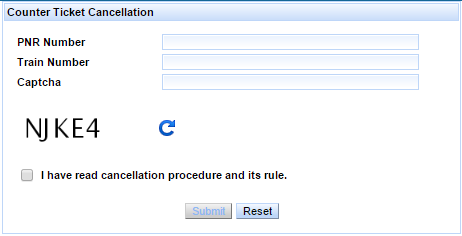
  1. Enter PNR Number, Train number along with Captcha.
  2. Select check box to confirm that rules and procedure are read.
  3. After click on submit an OTP will be sent on mobile number given at the time of booking, enter the received OTP and click submit.
  4. After the OTP is validated PNR details will be displayed on the screen.
  5. After verifying the details Click on ‘Cancel Ticket’ for full cancellation. Refund amount due will be displayed on the screen.
  6. An SMS will be sent with PNR and refund details. Sample format: “Your PNR xxxxxxxxxx has been cancelled. Collect refund amt xxxxx from journey commencing station or nearby satellite PRS locations. Ref. Terms & conditions”
  7. For tickets cancelled (including return journey tickets) before 24 hours of scheduled train departure time:
  8. Refund of fare as permissible can be collected on submission of original PRS counter ticket from any PRS counter of Indian Railways upto 4 hours before the scheduled departure time of the train in case of confirmed tickets and upto thirty minutes before the scheduled departure time of train in case of RAC/waitlisted tickets.
    For tickets cancelled (including return journey tickets) between 24 hours and upto 4 hours for the confirmed tickets and upto thirty minutes for RAC/waitlisted tickets before the scheduled departure time: Refund of cancelled PRS counter tickets through IRCTC website or 139 at present is permitted only at the journey commencing station or nearby satellite PRS locations by surrendering original journey ticket. Please check the convenience of collecting refund from journey commencing station before cancelling your ticket
    During first two hours of the opening of PRS counters on the next day for the tickets for the trains whose scheduled departure as under:- time is (i) between 1801 hours and 0600 hours.
    Upto 4 hours after the scheduled departure of the train during the working hours of PRS counters/current counters/special counters where cancellation is permitted round the clock on the tickets for the trains whose scheduled departure time is (i) between 0601 hours and 1800 hours.

Authority: www.irctc.co.in

Thursday, June 2, 2016

Two Years Achievements of Ministry of Railways (May 2014 to May 2016)

Two Years Achievements of Ministry of Railways (May 2014 to May 2016)

I .PASSENGER AMENITIES AND DIGITAL INDIA INITIATIVES
  • Indian Railways launched three social media platforms on Facebook, Twitter and You Tube with the handle @railminindia.  Ministry of Railways employed first of its kind, a real time 24×7 public grievance system through Twitter and provided medical, security and other emergency assistance to travelling passengers
  • All India Security Helpline 182 set up to report any untoward incident and seek emergency help during travel
  • The All India Passenger Helpline ‘138’ provided for all other query/complaints during travel
  • A mobile based application viz. Complaint Management System (COMS) launched
  • E-catering facility launched at 100 stations. 408 railway    stations designated for providing E-catering
  • A massive scheme for providing Water Vending Machines (WVMs) to provide RO Water at affordableprices is under implementation by Railway PSU IRCTC
  • Reservation quota of two lower berths per coach in Sleeper class enhanced to four lower berths per coach for Senior Citizens and Women
  • Tatkal reservation timings have been staggered to serve dual purpose of providing convenience to the passengers and for staggering traffic on the e-ticket portal.All agents are debarred from booking tickets during first thirty minutes of opening of booking
  • Automatic refund of Confirmed /RAC e-tickets on cancellation of trains similar to waitlisted e-tickets is granted without filing of TDR
  • Time limit for booking reserved tickets was increased to 120 days w.e.f. 01.04.2015
  • Destination alert and wake up alarm services launched on 139
  • Automatic Destination Alerts to passengers through SMS for Rajdhani and Duronto trains.
  • E-ticketing facility launched for disabled persons and for accredited journalist on concession pass.
  • Mobile charging facilities in all new general class coaches initiated.
  • Out of 1252 Stations identified for upgradation to Adarsh Stations’, 986 stations have so far been developed. 160 developed in last two years
  • Scheme namely ‘SMS Gateway’ launched enabling passengers to get SMS alerts on the status of reserved tickets
  • New Generation system put in place which can book 7200 online tickets instead of 2000 tickets per minute and can attend 2,00,000 enquiries instead of 50000 per minute
  • Rationalization of Computerized Passenger Reservation System (PRS) done to enable passengers to buy tickets even after the preparation of reservation charts
  • Paperless unreserved ticketing including Paperless Platforms tickets through mobile phone introduced in suburban sections of Western Railway, Central Railway, South Central Railway, Southern Railway, Eastern Railway, South Eastern Railway
  • Pilot Project of hand Held Terminals for TTEs launched
  • E-booking of disposable linen started on trains at New Delhi Railway Station and Nizamuddin Railway Station, Mumbai Central (BCT), Chattarpati Shivaji Terminus (CSTM), Southern Railway
  • E-booking of Wheel chair launched
  • Currency Coin cum Card operated Automatic Ticket Vending Machines installed at select stations.
  • Initiated one of the largest free public wifi fi systems in the world. Launched at 26 stations with a plan to extend it to 100 Stations by December this year and to 400 stations by 2018.
  • The booking of retiring rooms at different railway stations made online making it convenient and transparent
  • E-Ticketing portal in Hindi launched
  • 60 lifts and 150 escalators provided in last 2 years at Railway stations
  • Model Rake (a passenger carrying train with 24 coaches) developedwith improved interiors, colour scheme, aesthetics and amenity fittings. This is running as a train between New Delhi and Varanasi.
  • Cancellation of confirmed, RAC and Waitlisted PRS counter tickets made easy using IRCTC website or phone No. 139.
  • Provision made for acceptance of international debit and credit cards for payment of E-ticket through IRCTC website
  • Yatri Ticket/Sewa Kendra (YTSK) Scheme launched to allow private agents to operate ticketing terminals for selling reserved as well as unreserved tickets
  • Indian Railways started six pilgrims’ special tourist trains. More such trains being planned in subsequent phases
  • Dustbins to be provided in non AC coaches also
  • NIFT, Delhi has been engaged for designing of bedroll etc.
  • A new ‘Rail Neer’ plant for package drinking water set up at Ambernath (Mumbai).
  • In order to increase availability of accommodation for general class passengers on long distance Mail/Express trains, GMs were delegated powers to de-reserve Sleeper Class (SL) coaches as General Coaches (GS) in identified trains & sectors
  • Suvidha Trains with graded pricing structure introduced with facility for booking on PRS in addition to e-tickets and facility of limited refund on cancellation of ticket
  • The Defense Travel System to eliminate exchange of defense warrants was rolled out on the NGeT platform. Till date about 2000 Defense units have started issuing tickets through this platform without exchange of warrants
  • Number of berths available for physically challenged has been increased from 2 to 4
  • ‘VIKALP’, Alternative Train Accommodation System (ATAS)  launchedwith a view to provide confirmed accommodation to waitlisted passengers and also to ensure optimal utilization of available accommodation. This facility is now available on New Delhi – Jammu, New Delhi – Lucknow, Delhi-Howrah, Delhi- Chennai, Delhi-Mumbai and Delhi-Secunderabad Circuits,
  • Launched pre-cooked (ready-to-eat) meals of reputed brands on some trains.
  • Commencement of provision of Braille signage on 3000 coaches has been given in order to facilitate travel to visually impaired passengers.
  • Provision of foldable ladder in First AC coaches launched

  • Provision of Bio degradable garbage bags to passengers started on pilot basis

  • Escorting ladies special trains and ladies compartment by security squad

  • Security helpline 182 activated and real time complaint resolution through Twitter employed with a high priority to women security issues

  • Fitment of CCTV surveillance cameras for women security in trains initiated with first such fitment undertaken in Amritsar-New Delhi-Shan-e Punjab Express
  • Development of security App over some of the Zonal Railways
  • Middle bay reserved for women
  • Pilot Project of Sale of Unreserved Tickets  through Hand Held Terminals initiated at Hazrat Nizammudin Railway Station of Northern Railway.

  1. INFRASTRUCTURECREATION AND SUPPORT TO MAKE IN INDIA INITIATIVE
  • Indian Railways has taken a giant leap forward in ‘Make in India’ drive by signing Agreement for setting up of Diesel Locomotive Factory (DLF) at Marhowra, Saran district, Bihar for procurement and maintenance of mainline most modern high power Diesel Electric Locomotives with M/s GE Diesel Locomotive Pvt. Ltd. A separate agreement signed with M/S ALSTOM for setting up of electric locomotive factory at Madhepura, Bihar for procurement and maintenance of most modern high power electric locomotives, both major PPP and FDI tenders of Indian Railways. This would be one of the highest FDI’s in India amounting to order book of almost Rs 40,000 Crore.

  • The Ministry has initiated process for procuring high speed train sets which will improve average speed of passenger carrying trains thereby reducing journey time.

  • MoU between India and Japan signed for Mumbai–Ahmedabad High Speed Rail Project using Shinkansen Technology covering a total of 508 kms. A new entity named National High Speed Ra Extension of newly introduced cancellation facility for PRS
  • il Corporation Limited has been set up in February, 2016 to implement the project

  • Further high speed studies are being conducted by Ministry of Railways on Diamond Quadrilateral High Speed Rail network. Feasibility studies of Delhi- Mumbai, Mumbai- Chennai and Delhi- Kolkata are underway.  The feasibility studies of Delhi-Nagpur and Mumbai –Nagpur corridors are being taken up through G2G cooperation with Chinese and Spanish governments respectively

  • Ministry of Railways launched Gatimaan Express, country’s first semi high speed train with a maximum speed of 160 kmph between Delhi and Agra heralding a new era of high speed rail travel in India

  • Redevelopment of 400 Stations to be developed on e-bidding on as is where is basis; 10 stations handed over to IRSDC

  • Indian Railways commissioned 2828 Km of Broad Gauge lines, highest ever in 2015-16 against an average of 1528 Km from 2009-14.

  • IR commissioned two mega bridges over river Ganga at Patna and Munger.With these, the Railway networks of North and South Bihar have been integrated.

  • The executions of the biggest infrastructural projects in the country, Eastern and Western DFCs have been fast-tracked.  Revised cost estimates have been approved by the Cabinet and funding has been tied up.  Rs.25,320 Cr worth of contracts have been awarded in the last two years, which is more than double of the total contracts of Rs.12,240 Cr awarded since commencement. The first ever section on DFC of 56 km between Durgawati-Sasaram has been commissioned. The project is progressing well for commissioning in phases by 2019

  • Rail Wheel Plant, Bela commissioned and regular production started

  • Diesel loco factory at Varanasi is being expanded

  • DEMU factory at Haldia was commissioned and Mid-life Rehabilitation Workshop for coaches at Jhansi completed.

  • One of the most challenging railway projects, conversion of 1500 V DC to 25000 V AC traction system has been successfully completed over the entire Mumbai division of Central Railway.

  • During 2014-16, 3105 route kilometres have been electrified, which is an average of 1552.5 RKM/ annum as against 1236 RKM/annum during previous five years.

  • Construction of Electric Lolo Assembly & Ancillary Unit of CLW at Dankuni in West Bengal completed

  • Modern LHB Coach manufacturing facility commissioned at ICF Chennai.

  • The Chhapra factory has started regular production of cast wheels for rolling stock. The installed capacity of the plant is 1Lac wheels per annum.

  • Foundation stone laid for setting up Traction Alternator Factory at Vidisha to manufacture 100 traction alternators per annum of high horse power diesel locomotives which are currently being imported

  • Significant boost in elimination of unmanned level crossing which has resulted in safe operations. In 2015-16, a total of 1253 unmanned level crossings were eliminated and 1024 Road over/ Road under bridges were constructed. This marks an improvement of 35% against the average number from 2009-2014

III.REFORMS
  • A Memorandum of Understanding with LIC of India for obtaining funds to the tune of Rs.1.5 lakh Cr signed.
  • MOF approved issue of tax free bonds by IRFC amounting to Rs.6,000 Cr
  • Discussions initiated with World Bank for setting up a Railway Infrastructure Development Fund of around USD 30 Bn
  • Powers delegated and decentralized for improving efficiency and transparency. Measures for E-tendering, E-auctioning, E-ticketing, E-Governance, E-Freight Demand, E-Catering, E-Wheel Chair, E-Concierge etc. takenfor efficiency and transparency
  • Ministry of Railways (MoR) signed Memorandum of Understanding (MoU) for formation of Joint Venture Companies with six State Governments viz. Odisha, Maharashtra, Andhra Pradesh, Kerala, Chhattisgarh and Telangana.JVs would undertake project development works for an identified basket of projects, which will inter-alia include surveys, preparation of Detailed Project Report (DPR) and getting requisite approvals, processing for sanctioning of identified projects and monitoring
  • Ministry of Railways conducted world’s largest online exam for recruitment for almost 90 lakh aspirants. With a view to increase transparency, a new system of handing over the Question Booklets to the candidates has been introduced.A pilot project of uploading of Answer Keys and Cut-off marks has also been initiated.
  • Deloitte, a consulting firm has been engaged for studying the manpower rationalization of the Group A services.  Report submitted and is under examination
  • Four Centres of Railways Research set up in premier educational institutions
  • Development of an online system initiated for grievance redressal of both serving as well as retired railwaymen
  • Railways signed MoU to set up its own Railway Design Centre in collaboration with  National Institute of Design (NID)
  • The process for putting in place a regulator “Rail Development Authority” has been initiated. A concept note was uploaded to receive feedback from all stakeholders. Process for drafting of a bill/executive order underway.
  • 100 % FDI allowed in identified areas of railway sector and sectoral guidelines on FDI formulated
  • Ministry of Railways implemented 100% E-procurement solution for all kinds of contracts – goods, works and services. It isIndia’s largest e-procurement system
  • A web-enabled IT-Application “Project Monitoring and Information System (PMIS)” launched which will be implemented in Udhampur-Srinagar-Baramullah Rail Link (USBRL) project, followed by other mega and complex projects of Indian Railways. This will increase transparency in project monitoring

  • “Technology Mission on Indian Railways (TMIR)” for Development/Research/Innovations in Railway Technologies in association with Department of Science & Technology, MoHRD and representatives of Industry has been set up
  • Creation of Mobility Directorate in Railway Board’s Office
  • Creation of Non-Fare Revenue Directorate in Railway Board’s Office
  • Release of Handout on ‘Railway initiatives for Ease of Doing Business’ and Nomination of ‘Key Customer Managers’

  1. GREEN INITIATIVES
  • Commissioned 26 MW wind mill power plant at Jaisalmer
  • 10MW Solar Plants installed in two years. Massive solarisation (1000 MW Solar Power Plants) planned in next Five years with an eye on making Railways, the largest solar power producer in the country
  • Railways provided27,000 bio-toilets in trains in the last two years.A target of 30000 bio-toilets setfor the next financial year
  • First ‘Green’ DEMU train introduced on Northern Railway to run between Rewari-Rohtak section
  • A hybrid toilet system, combining best features of a   vacuum toilet system and indigenous bio-toilet system has been installed for trial in a First Class air conditioned coach of Dibrugarh Rajdhani which is running wellsince September 2015. The system does not require any waste handling facilities for evacuation and processing of waste. This system uses significantly less quantity of water is used for flushing
  • A new separate Environment Management Directorate formed to address all environment related issues in a focused and integrated manner
  • M/s. RITES has been engaged for setting up of two pilot plants at NDLS and JP for disposal for Municipal Solid Waste (MSW) in an environment friendly manner including conversion of Waste to Energy (bio-methanation)
  • A major push was given to get additional sanction of more than 30 Water Recycling Plants during 2015-16. As against this, less than 30 WRPs have been functioning all these years
  • Setting up of Automatic Coach Washing Plants in major coach maintenance depots
  • After field trails, IR has now developed the environmental friendly composite sleepers made up of recycled plastic waste, which will be used over all girder bridges in future for improved maintainability and facilitating higher speeds and higher axle loads.
  • Indian Railways has started a massive exercise of planting trees alongside Railway Track with the signing agreement with Haryana & Punjab Government in the first phase.
V. CLEANLINESS
Indian Railways joined the Swacch Bharat Abhiyan in a big way. It formulated an integrated policy on cleanliness

  • 27 Charitable Institutions/Social Organizations invited to take part in ‘Swachh Rail, Swachh Bharat Abhiyan’ through Shramdaan campaign

  • Criterion for qualification of OBHS trains revised to include all importantmail &express trains. 7 more Clean Train Stations added and 240 new trains added on OBHS in last two years

  • “Clean My Coach” Servicelaunched for any cleaning requirement in the coach. A passenger can send an SMS on a mobile number 58888 or book through app and his request is attended to

  • 16 more mechanised laundries set up in the last two years. Now around 45 percent linen is cleanedthrough mechanised laundries

  • Intensive mechanised cleaning of coaching in coaching depots through professional agencies – 132 Coaching Depots in different Railways already have the system

  • Cleaning of 50 major stations has been outsourced to professional agencies

  • Cleanliness audit through 3rd party started for Railway stations institutionalised. Ranking of stations based on cleanliness would be generated periodically

  1. CONNECTIVITY IN NORTH EAST AND J&K
  • Indian Railways completed Udhampur-Katra Broad gauge line in the State of Jammu and Kashmir bringing Katra on Broad Gauge Railway map
  • Lumding-Silchar Broad gauge section inaugurated giving seamless BG connectivity to Barak Valley of Assam
  • Meghalaya came on the rail map with the flagging off the first ever train from Guwahati to Medipathar in Meghalaya
  • The Prime Minister laid the foundation for a new line to take rail connectivity to Mizoram’s capital Aizwal
  • The Tripura’s Capital Agartala came on the broad gauge rail map
  • Meter gauge will be fully eliminated in North-East in near future
  • IR commissioned 545 KM of Broad Gauge lines in North East in 2015-16 in comparison to 110 KM per year from 2009-2014

VII.PPP IN RAIL LINE PROJECTS
  • In 2015-16, Indian Railways generated an investment of Rs.15,000Cr through PPP. This is the highest achieved till now.
  • Partnership with State Governments, Industry is being encouraged to undertake coal and mining connectivity projects.
  • To encourage port connectivity projects, thrust has been given to implementation of projects under the participative model policy of 2012. Rail connectivity to Tuna Port at a cost of 142 Cr has been implemented in 2015. Also approvals under Joint Venture model have been granted to build rail connectivity to the ports of Jaigarh (Rs 771 Cr.), Rewas (Rs.349 Cr), and Dighi (Rs.724 Cr.)

  • Ministry of Railways for the first time has decided to launch three annuity projects Badrak- Nargundi 3rd line (900Cr.), Nagpur – Wardha 3rd line 550Cr. and Kazipet- Vijayawada 3rd line 1566 Cr in the current calendar year.

VIII. FREIGHT
  • Massive rationalization of freight policies initiated
  • Merry-Go-Round system introduced to capture short lead traffic near steel plants and thermal power house
  • Post congestion charges withdrawn which will help in increasing traffic from the Ports to hinterland
  • Two-Point/Multi Point/Mini Rake facility extended to maximize traffic.
  • Roll on – Roll off scheme launched on Digha Rail Bridge over River Ganges near Patna. Under this scheme loaded trucks would be moved on the flat wagons to avoid congested roads across Ganges
  • Busy season charge withdrawn.
  • Automatic Freight Rebate Scheme for traffic loaded in Traditional Empty Flow Direction introduced
  • Computerized system to register demands for wagons introduced. Electronic forwarding note and Electronic Railway Receipts introduced to enhance efficiency and transparency in freight operations
  • Liberalised Wagon Investment Scheme, Wagon Leasing Scheme, Special Freight Train Operator Scheme, Private Freight Terminals, Automobile Freight Train Operator Scheme, accelerated to improve freight
  • Auto hub at Walajabad in Chennai Division developed for automobiles moment
  • Flagging off of Roll-On-Roll-Off(Ro-Ro) train Ex.-Bihta to Turki in Bihar.

  1. SAFETY IN RAIL OPERATIONS

  • Working towards ‘Zero Accident’ Mission.
  • TPWS is a safety Automatic Train Protection (ATP) system conforming to European Train Control System (ETCS) Level-1.    TPWS trials at 160 Kmph were successfully conducted.
  • 282 Level Crossing Gates have been interlocked with Signals to enhance safety.
  • A cost effective indigenous safety system – Train Collision Avoidance System (TCAS) is being developed indigenously by RDSO and the trails are on.
  • Pilot Project initiated for Improving Safety at Unmanned Level Crossing which include automatic warning to road users through flasher light and Sensing of Obstruction on level crossing and visual warning to train drivers

  1. MISCELLANEOUS
  • In the last two years, 14 MoUs/MoCs/other agreements for cooperation in rail sector have signed with Railways/Governments of Czech Republic, China, South Korea, Canada, Kazakhstan, Slovak Republic, UK, Japan, Germany, France, Russia & Sweden.
  • Under Skill India Initiative, 53 locations across the country have been identified by setting up training centres
  • Indian Railways made successful arrangements to transport drinking water to drought-affected areas of Latur district in Maharashtra
  • Indian Railways lent helping hand during the Nepal earthquake tragedy by providing ‘Rail Neer’ bottles and by transporting Nepal evacuees
  • Railways also helped during the J&K floods
  • Railways were in the forefront in extending help to the Indian nationals returning from Yemen
  • Indian Railway weightlifters (5 Women & 1 Men) represented India in the Commonwealth Youth; Junior & Senior Weightlifting Championship held at Pune from 11th to 15th November, 201. All Railway players won medals in this Championship
  • Memorandum of Understanding (MoU) signed Ministry of Railways and PEC University of Technology for setting up of ‘Kalpana Chawla Chair’ on Geospatial Technology for Indian Railways at PEC University of Technology, Chandigarh.
PIB

Sunday, March 6, 2016

Highlights of Railway Budget 2016-17 in Questions and Answers Format (Q & A Format)

Highlights of Railway Budget 2016-17 in Questions and Answers Format (Q & A Format)

railway-news-Highlights-Railway-Budget-2016-17-QA

Ministry of Railways
Press Information Bureau,
Government of India
03-March 2016

For the Convenience, the Highlights of Railway Budget, 2016-17 have been complied in questions and answers format which is given below : – Rail Budget 2016-17

Q. What is the theme of this Budget?
  • To Reorganise, Restructure and Rejuvenate Indian Railways.
    · A new approach, a new way of working – “चलो, मिलकर कुछ नया करें”.
  • Objectives:
    Ø to improve customer service,
    Ø regain the lost modal share, and
    Ø to introduce a new way of working by relooking the processes and structures.
  • 3 pillars of the strategy :
    Ø Nav Arjan or New revenues (focus on new sources of revenue),
    Ø Nav Manak or New norms (optimising outgo on each activity), and
    Ø Nav Sanrachna or New Structures (revisiting all processes, rules, and structures).
Q Is this budget reform oriented?
  • Yes, the Budget 2016-17 focusses on consolidation of the vision set out in the Budget 2015-16.
  • Draft Bill on regulator to be finalized
  • Restructuring Railway Board on business lines
  • Forming cross-sectoral directorates
  • Setting up Railway Planning and Investment Organisation
  • Setting up a holding company for Railway PSUs
  • Creating a separate organization Special Railway Establishment for Strategic Technology & Holistic Advancement (SRESTHA) for R&D
  • Creating an organization Special Unit for Transportation Research and Analytics (SUTRA) for data analytics
  • Setting up duly empowered missions to take forward 7 activities with time bound targets – missions are for switching over to 25 tonne axle load, increasing speeds, accounting reforms, commissioning 100 sidings/PFTs in 2016-17, preparing a blueprint of utilizing the network once DFC is commissioned, zero accident for safety and for procurement and consumption efficiency.
Q How is capacity augmentation planned?
  • Plan Budget is pegged at Rs. 1.21 lakh crore, 21% higher than the expected Plan expenditure in 2015-16.
  • 2015-16 will surpass target of commissioning 2,500 km Broad Gauge lines.
  • 2016-17 commissioning of 2,800 kms of Broad Gauge track.
  • 90 new projects involving a total investment of Rs. 1,26,172 crore covering about 8,432 kms covering new line, doubling, gauge conversion and Metropolitan Transport Project (MTP) included in the Budget.
  • In 2016-17, Broad Gauge lines at the rate of over 7 km per day against an average of about 4.3 Km per day in the last 6 years.
  • This pace will increase to about 13 kms per day in 2017-18 and 19 kms per day in 2018-19
  • Railway Electrification – 1,600 kms to be commissioned in 2015-16; in 2016-17 propose to electrify 2,000 kms.
  • High speed passenger corridor from Ahmedabad to Mumbai; SPV to be registered; will bring in modern technology for the country.
  • DFC – three new freight corridors: North-South connecting Delhi to Chennai, East-West connecting Kharagpur to Mumbai & East Coast connecting Kharagpur to Vijayawada through innovative financing mechanisms including PPP
  • Port connectivity: Tuna Port commissioned in 2015-16 and rail connectivity projects to ports of Jaigarh, Dighi, Rewas and Paradip under implementation. For 2016-17, to take up connectivity for the ports of Nargol and Hazira under PPP.
Q What is there for the Common Man?
  • Introduction of Antyodaya Express, a long-distance, fully unreserved, superfast train service, to be operated on dense routes
  • Addition of two to four Deen Dayalu coaches in some long distance trains for unreserved travel with facility for potable drinking water and a higher number of mobile charging points
  • Sale of tickets through hand held terminals
  • Sale of platform tickets through ticket vending machines both cash and card compatible
  • E-ticketing facility to foreign debit/credit cards for foreign tourists and NRIs
    Facility of cancellation through the 139 helpline using ‘One Time Password’
  • Bar coded tickets, scanners and access control on a pilot basis
  • Progressive CCTV coverage at tatkaal counters
  • ‘Vikalp’ (Alternative Train Accommodation System) scheme to be expanded to provide choice of accommodation in specific trains to wait-listed passengers.
  • IRCTC to manage catering services in a phased manner.
  • Extending e-catering services from 45 stations to all 408 ‘A-1’ and ‘A’ class stations.
  • Explore making mandatory catering services optional in trains.
  • Introducing a new policy where each stall at station can provide multiple products including milk products and OTC medicines
  • Option to our customers for drinking tea in kulhad
  • To convert all operational halts into commercial halts.
  • Information boards in trains to list on-board services and also GPS based digital displays inside coaches to provide information regarding halts.
  • A1 class stations to be manned with duly empowered Station Directors supported by cross functional teams.
  • Passenger amenities and beautification on stations at pilgrimage centres including Ajmer, Amritsar, Bihar Sharif, Chengannur, Dwarka, Gaya, Haridwar, Mathura, Nagapattinam, Nanded, Nasik, Pali, Parasnath, Puri, Tirupati, Vailankanni, Varanasi and Vasco.
  • Aastha circuit trains to connect important pilgrim centres.
  • Porters to have new uniforms and train them in soft skills, to be henceforth called sahayak.
Q What is there for Cleanliness?
  • ‘Clean my Coach’ service through SMS.
  • Ranking of A1 and A stations based on periodic third party audit and passenger feedback.
  • Waste segregation and recycling centres.
  • ‘Awareness campaigns’ for cleanliness.
  • Additional 30,000 bio-toilets.
  • Providing portable structures with bio-toilets at all platforms of select stations for senior citizens, Divyang and women travellers.
Q What is there for farmers?
  • Encouraging development of cold storage facilities on vacant land near freight terminals. Local farmers and fishermen would be given preferential usage of the facility. A policy in this regard would be issued in the next 3 months.
  • Allowing floriculture/horticulture along tracks.
Q What is there for Industry?
  • Expanding the freight basket by looking beyond core commodities
  • Starting a time-tabled freight container, parcel and special commodity trains on a pilot basis
  • Container sector to be opened to all traffic barring coal and specified mineral ores and part-loads during the non-peak season.
  • Existing terminals/sheds to grant access to container traffic, where feasible
  • Review of tariff policy to evolve a competitive rate structure vis a vis other modes, permit multi-point loading/unloading and apply differentiated tariffs to increase utilization of alternate routes
  • Signing long term tariff contracts with key freight customers using pre-determined price escalation principles
  • To develop Rail side logistic parks and warehousing in PPP mode
  • 10 goods sheds to be developed by Transport Logistics Company of India (TRANSLOC) in 2016-17.
  • Inaugurating soon India’s first rail auto hub in Chennai to capture automobile traffic.
  • Exploring feasibility of opening up leasing of general purpose wagons.
  • Appointing Key Customer Managers to liaison with our major freight stakeholders.
Q. What are the measures for environment and energy conservation?
  • To reduce energy consumption in non-traction area by 10% to 15%; all new light provisions will be LED luminaire only
  • More than 2,000 locations provided with Rain Water Harvesting (RWH) facility; RWH systems will be provided in a phased manner in all establishments having rooftop areas of more than 200 square metres
  • Environmentally friendly composite sleepers made up of recycled plastic waste will be used over all girder bridges
    · Tender documents for 50 MW solar plants at rooftop issued and facility for another 100 MW being set up
  • To commission 132.5 MW of windmill power plants in 2016-17
  • Automatic coach washing plants to be commissioned in major coaching depots with a holding of more than 500 coaches
  • To convert all production units as well as at least one workshop in each Zonal Railway as green industrial unit
Q. Are there any measures in the budget for Staff Welfare?
  • To tie up with the Ministry of Health for ensuring an exchange between Railways hospitals and Government hospitals.
  • Introduce ‘AYUSH’ systems in 5 Railway hospitals.
  • All gang men to be provided devices called ‘Rakshak’ which will intimate them about approaching trains.
  • to reduce weight of the tools carried by gangmen while patrolling
  • Provide toilets and air-conditioning in cabs for loco pilots.
  • one C T Venugopal chair on Strategic Finance, research and policy development
  • One Kalpana Chawla chair on geo-spatial technology for IR.
  • Rail University at Vadodara
  • Skill development on IR premises with Ministry of Skill Development
  • Railway Workshops and Production Units to develop ‘Centres of Excellence for Skill Development’, focussing on one/two specialized activities for the general public
  • Join hands with prominent NGOs to provide skilling to people in remote areas including wards of Railways employees.
Q. Are there any passenger friendly initiatives to cater to special needs, including Senior Citizens, Divyang (differently-abled) etc?
  • Expansion of Sarathi Seva to help old and disabled passengers requiring assistance at stations.
  • Strengthen existing services for enabling passengers to book battery operated cars, porter services, pick up and drop, and wheel chair services – Rail Mitra Sewa.
  • Ensuring all stations under redevelopment are accessible by Divyang
  • At least one Divyang friendly toilet at each platform in A1 class stations in 2016-17.
Q Are there any measures for the business traveller?
  • For passengers transiting railway network for freshening up before moving on with their business for the day, hourly booking of retiring rooms to be allowed instead of the existing minimum of 12 hours.
  • Retiring rooms to be handed over to IRCTC for management.
Q What is there for Suburban systems?
  • Mumbai Urban Transport Project (MUTP) III to be taken forward.
  • Financial closure and an early award of tenders for two elevated suburban corridors between Churchgate-Virar and CSTM-Panvel
  • Raise all low level platforms in Mumbai suburban stations in 2016-17
  • Issues related to East West Corridor of Kolkata Metro resolved and Phase I will be completed by June 2018; working on the possibility of extending the East West Corridor by 5 km.
  • Reviving the Ring Railway system in Delhi in partnership with the State Government.
  • Major programme to build an integrated suburban ecosystem of IR by launching a new investment framework with sharing of equity contribution with the State Governments and ensuring cost neutrality on operations; detailed policy in 4 months.
  • Partnership with State Governments of Gujarat, Telengana, Karnataka, Kerala and Tamil Nadu for developing suburban sections in Ahmedabad, Hyderabad, Bengaluru, Thiruvananthapuram and Chennai, respectively by deploying innovative financing mechanisms.
Q Are there any measures for Women?
  • To make available of children’s menu items on trains.
  • Baby foods, hot milk and hot water to be made available on stations
  • Changing boards for babies would be provided in train toilets.
  • CCTV cameras would continue to be installed in coaches
  • Sub-quota in allotment of stalls
  • Encouragement to self-help groups to supply food on trains
Q. Are there any measures for youth?
  • Open up IR to 100 students across Engineering and MBA schools for 2-6 months’ internships each year.
  • Wi-Fi at 400 stations in next two years
  • Rs. 50 crore earmarked for Innovation Fund for encouraging innovations and start-ups.
Q. Are there any measures for journalists?
  • E-booking of tickets on the concessional passes available to them
Q What is there for the North East & J&K?
  • States of Mizoram and Manipur will come on the Broad Gauge map of the country with commissioning of the Kathakal-Bhairabi and Arunachal-Jiribam Gauge Conversion projects.
  • Decongestion work on the Jalandhar- Jammu line, an important link to the valley, is going on in full swing. Doubling of two bridges will be commissioned by March 2016, while the other two bridges will be completed by 2016-17.
Q What are the provisions for Technology?
  • Integrating various facilities into two mobile apps – one dealing with all ticketing issues and the other for receipt and redressal of complaints and suggestions.
  • Physical progress on DFC to be monitored in 2016-17 using latest drone and Geo Spatial based satellite technology
  • Initiated system wide integration of IT programs/systems, both horizontal and vertical, akin to an ERP through innovative partnership models.
  • Process leading to award of tenders electronically to be rolled out on a Pan-India basis in 2016-17.
Q Is there anything related to innovation and startups?
  • Setting aside a sum of Rs. 50 crore for innovation grants to employees, startups and growth oriented small businesses
  • Innovation labs to be set up in workshops and production units to support creative innovation by locals and staff.
  • Annual innovation challenge
  • To develop a Test Track for testing prototypes.

Q What is there for State Governments?
  • Creation of Joint Ventures with State Governments for undertaking rail based projects. Received in principle approval from 17 states, out of which 6 MOUs have already been signed.
  • 44 new line, gauge conversion and doubling projects proposed in partnership mode
Q How are resources proposed to be mobilized?
  • LIC has agreed to invest Rs. 1.5 lakh crore over five years on extremely favourable terms.
  • Looking forward to setting up a Fund with multilateral assistance for financing railway projects.
  • Non fare revenues
  • Station redevelopment will help monetize land and buildings through commercial exploitation of vacant land and space rights over station buildings.
  • Monetizing land along tracks
  • Monetizing soft assets such as data, software and some of the free services such as PNR enquiry, e-commerce activities on IRCTC website.
  • Target to increase the advertising revenues by more than 4 times the current revenues.
  • To liberalize the current parcel policies including opening the sector to container train operators
  • Expanding our service offerings specially to growing sectors such as e-commerce.
  • Pilot project for online booking of parcels.
  • Revenues from manufacturing activity of production units and workshops for domestic and international market; revenue targeted at Rs. 4,000 crore by 2020.
Q Make in India
  • After agreement for setting up two loco factories in India with an order book of about Rs. 40,000 crore, a similar bid process started for train sets for Rajdhani and Shatabdi services; current procurement to be increased by 30%.
  • Production units and workshops to aim at generating annualised revenues of about Rs 4,000 crore by 2020 through manufacturing products for domestic and international markets.
Q Is there anything special for the passenger services?
For the unreserved passenger
  • Antyodaya Express, a long-distance, fully unreserved, superfast train service, to be operated on dense routes.
  • Addition of two to four Deen Dayalu coaches in some long distance trains with facility for potable drinking water and a higher number of mobile charging points.
  • For the reserved passenger
  • Humsafar would be fully air-conditioned third AC service with an optional service for meals.
  • Tejas will showcase the future of train travel in India. Operating at speeds of 130 kmph and above, it will offer onboard entertainment, local cuisine, Wi-Fi, etc.
  • Overnight double-decker, Utkrisht Double-Decker Air-conditioned Yatri (UDAY) Express on the busiest routes.
  • Modern coaches
  • Designing coaches to ensure higher carrying capacity and automatic doors, bar-code readers, bio-vacuum toilets, water-level indicators, accessible dustbins, ergonomic seating, improved aesthetics, vending machines, entertainment screens, LED lit boards for advertising, PA system.
Q Have any social initiatives been announced?
  • IRCTC has begun the process of empanelling Self-help groups for providing catering/cooking services.
  • Partnering with NABARD to provide support and access to our IRCTC website to ensure extensive e- marketing for products produced by the Self-help groups.
  • Partnered with Khadi and Village Industries Commission to support creation of employment and self-reliance in rural India resulting in the generation of 17 lakh man days; will continue to partner with them
  • Will encourage sourcing of products from SC/ST entrepreneurs.

Q Are there any measures related to tourism?
  • Partner with the State Governments for operating tourist circuit trains and explore the possibility of a revenue sharing model.
  • Recently upgraded our National Rail Museum; promotion of tourism through Railway museums and UNESCO world heritage Railways
  • To spread awareness about our National Animal, the Tiger, we will offer complete packages including train journey, safaris and accommodation to cover the wildlife circuit comprising Kanha, Pench and Bandhavgarh.
*********
PIB

Tuesday, March 3, 2015

Railway Board Order: Advance reservation period increased from 60 days to 120 days w.e.f.1.4.2015

Railway Board Order: Advance reservation period increased from 60 days to 120 days w.e.f.1.4.2015


It has been decided to increase the advance reservation period from 60 days to 120 days (excluding the date of journey) w.e.f. 01.04.2015. CRIS will make necessary changes in the software for this purpose under intimation to all Zonal Railways as well as Board’s office.

There will be no change in case of certain day time Express Trains like Taj Express, Gomti Express, special trains, etc. where lower time limits for advance reservations are at present in force. There will also be no change in case of the limit of 360 days for foreign tourists.

Board desire that the above change may be given wide publicity well in advance of its implementation. Suitable instructions to all concerned may be issued to ensure smooth change-over to the new time limit.

Time limit for Advance Reservations in Railways has been increased from 60 to 120 days effective from 1.4.2015

Railway board issued orders on increasing the time limit for advance reservation in IRCTC has been enhanced from 1st April 2015

Source: 90paisa blog

Thursday, February 26, 2015

Railway Budget 2015: No hike in Railway Passenger Fares

No hike in Railway Passenger Fares
  • Plan Outlay proposed Rs. 1,00,011 crore, increased by 52%
  • Allocation for passenger amenities up by 67%
  • Railways to become prime mover of Indian Economy, Five years action plan proposed
  • Rail Budget seeks resource mobilization for higher investment
  • Thrust on measurable and sustainable improvement in passenger experience and to make Rail a safer means of travel
  • Hot buttons, coin vending machines for railway tickets within 5 minutes, e-catering to select meals from an array of choices
  • 200 more stations to come under Adarsh Station scheme; Wi – Fi to be provided at B category stations
  • 24X7 helplines for attending passenger problems and security related complaints
  • For the safety of women passengers surveillance cameras in suburban coaches
  • More General class coaches will be added in identified trains.
  • The speed of nine railway corridors will be increased to 160 and 200 kmph
  • Train Protection Warning System and Train Collision Avoidance System to be installed on select routes
  • 77 new projects covering 9,400 km of doubling/tripling/quadrupling works proposed
  • A new department for keeping stations and trains clean under Swachh Rail Swachh Bharat Abhiyan
Railway Budget presented today in Parliament proposed measures to make Indian Railways prime mover of Indian Economy once again. It seeks resource mobilization for higher investment, decongestion of heavy haul routes and speeding of trains and project delivery, better passenger amenities and safety, and to make railways a preferred mode of transport for masses. Presenting the Budget in Parliament, Railway Minister, Shri Suresh Prabhakar Prabhu said that all critical initiatives proposed will be pursued in mission mode.
The Budget proposals have set four goals to transform Indian Railways over next five years which are- a sustainable and measurable improvement in customer experience, make rail a safer means of travel, expansion of capacity substantially , modernization of infrastructure and finally to make railways financially self-sustainable. To achieve these goals the budget proposes five drivers which include adopting a medium-term perspective plan consisting of White Paper, a Vision-2030 document and a five year action plan. Building Partnerships with key stakeholders for long term financing and overseas technology, improving last mile connectivity, expanding fleet of rolling stock and modernization of station infrastructure are included in these drivers. Railways will also leverage additional resources; envisages investment of Rs. 8.5 lakh crore in next five years.

Revamping management practices, systems, processes, and re-tooling of human resources will be taken up by the Railways to achieve targeted operating ratio for 2015-16 at 88.5%. Fast decision making, tight accountability, improved management information systems and better training and development of human resource will also be part of the action plan to achieve the goals.

In order to make travel on Indian Railways a happy experience, the Budget has given thrust on Cleanliness and proposes a new department for keeping stations and trains clean under Swachh Rail Swachh Bharat Abhiyan. New toilets will be built at 650 additional stations; online booking of disposable bed rolls will be made available. 24X7 helpline number 138;toll-free number 182 for security related complaints have also been proposed in the budget.

In order to make ticketing more passenger friendly the Budget proposes “operation five minutes” for issuing unreserved tickets, hot buttons, coin vending machines, concessional e-tickets for differently abled travelers, for booking tickets a multi-lingual e-portal will be developed. Crediting of refunds through banks and unreserved tickets on Smart phones will be available. Proliferation of automatic ticket vending machines with smart cards and currency options, integrated ticketing system on the lines of rail-cum-road tickets, Defence Travel System developed for elimination of Warrants have also been proposed in the Budget.

The Budget has proposed e-catering to select meals from an array of choices. Ordering food through IRCTC website at the time of booking of tickets; integrating best food chains into this project; setting up of Base Kitchens in specified divisions to be run by reputed agencies for serving quality food and expansion of water vending machines will be taken up.

Hand-held terminals to Travelling Ticket Examiners (TTEs) for verification of passengers will now be provided for verification of passengers, possibility of extending facility of SMS on mobiles as a valid proof of travel for PRS tickets will be explored. A centrally managed Railway Display Network in over 2000 stations in next two years will be included besides “SMS Alert” service to inform passengers in advance of the updated arrival/departure time of trains at starting or destination stations.

For the safety of women passengers surveillance cameras will be provided on a pilot basis in selected mainline coaches and ladies’ compartments of suburban coaches.

The Railways will also take up a project for introducing on-board entertainment on select Shatabdi trains; Mobile phone charging facilities will be provided in general class coaches & will be increased in sleeper class coaches.

Now, 200 more stations to come under Adarsh Station scheme; Wi – Fi to be provided at B category stations; facility of self-operated lockers will be available at stations. Passenger capacity in identified trains will be augmented; more General class coaches will be added in identified trains. The Railways has also approached NID to design user friendly ladders for climbing upper berths. It has also proposed more quota of lower berths for senior citizens. TTEs will now be instructed to help senior citizens, pregnant women and differently-abled persons in obtaining lower berths; middle bay of coaches to be reserved for women and senior citizen. Provision of Rs. 120 crore has been made for Lifts and escalator; newly manufactured coaches will now be Braille enabled; building wider entrances for the ease of differently-abled passengers; allocation for passenger amenities up by 67%.

The Railways has proposed to revamp its station development policy completely and simplifies process for faster development by inviting open bids. It has proposed to develop 10 Satellite Railway terminals in major cities with twin purpose of decongesting the city and providing services to suburban passengers.

Seventy seven projects covering 9,400 km of doubling/tripling/quadrupling works along with electrification, covering almost all States, at a cost of Rs. 96,182 crore will be taken up. Traffic facility works a top priority with outlay of Rs. 2374 crore have been proposed. In order to accelerate the pace of Railway electrification, 6,608 route kilometres will be sanctioned for 2015-16, an increase of 1330% over the previous year.

As per the Budget proposal, the speed of 9 railway corridors will be increased from existing 110 and 130 kmph to 160 and 200 kmph respectively so that inter-metro journeys like Delhi-Kolkata and Delhi-Mumbai can be completed overnight. Average speed of freight trains in empty and loaded conditions, will be enhanced to 100 kmph for empty freight trains and 75 kmph for loaded trains.

Declaring safety of paramount importance for Railways, an action plan has been proposed for accident prone areas. The Budget also proposes 970 ROB/RUBs and other safety-related works to eliminate 3438 level crossings at a total expense of Rs. 6,581 crore, 2600% higher than the previous year. Train Protection Warning System and Train Collision Avoidance System will be installed on select routes at the earliest.

The Budget proposes constituting an innovation council called “Kayakalp” for business re-engineering and introducing a spirit of innovation in Railways besides setting up of Technology portal to invite innovative technological solutions. Four Railway Research Centers in select universities for fundamental research have also been proposed besides ‘Malaviya Chair’ for Railway Technology at IIT (BHU), Varanasi.

PPP cell of Railways will be revamped to make it result oriented, “Foreign Rail Technology Cooperation scheme” will be launched. Joint ventures will be set up with States for focused project development, resource mobilization, land acquisition, project implementation and monitoring of critical rail projects. In order to meet the requirements of new lines JVs will also be set up with major public sector customers.
Rail Budget has also proposed Coastal Connectivity Program in partnership with ports for Nargol, Chharra, Dighi, Rewas and Tuna. Besides this, projects worth Rs 2500 crore will be taken up through BOT/ Annuity route. These include Wardha- Nagpur 3rd line, Kazipet-Vijaywada 3rd line, Bhadrak –Nargundi 3rd line and Bhuj- Nalia Gauge Conversion.

In order to make Indian Railways more environment friendly, 100 DEMUs will be enabled for dual fuel – CNG and diesel. Locomotives running on LNG are also currently under development. Noise levels of locos to be at par with international norms; concerns related to wildlife to be addressed.

As a part of its social initiatives, now Rail stations and training centers will be made available for skill development. Incredible Rail for Incredible India will be launched and training of auto-rickshaw and taxi-operators as tourist-guides on the model of Konkan Railway will be taken up for tourism promotion. IRCTC will work on promoting the Gandhi circuit to attract tourists to mark the occasion of 100 years of the return of Mahatma Gandhi to India from South Africa. Kisan Yatra, a special travel scheme for farmers for farming & marketing technique centres has also been proposed.

According to Budget Estimates, Plan Outlay for 2015-16 has been proposed to Rs 1,00,011 crore, an increase of 52% over RE 2014-15 plan size. Out of this 41.6% resources will come from Central Government support while 17.8 % will be generated from internal resources.

– PIB